Guide
Building a villa in Geneva: what to know before you build
Zone 5, floor area ratio, energy standard, open ground and construction costs: the Geneva rules that shape a villa project, and the steps to carry it out methodically.
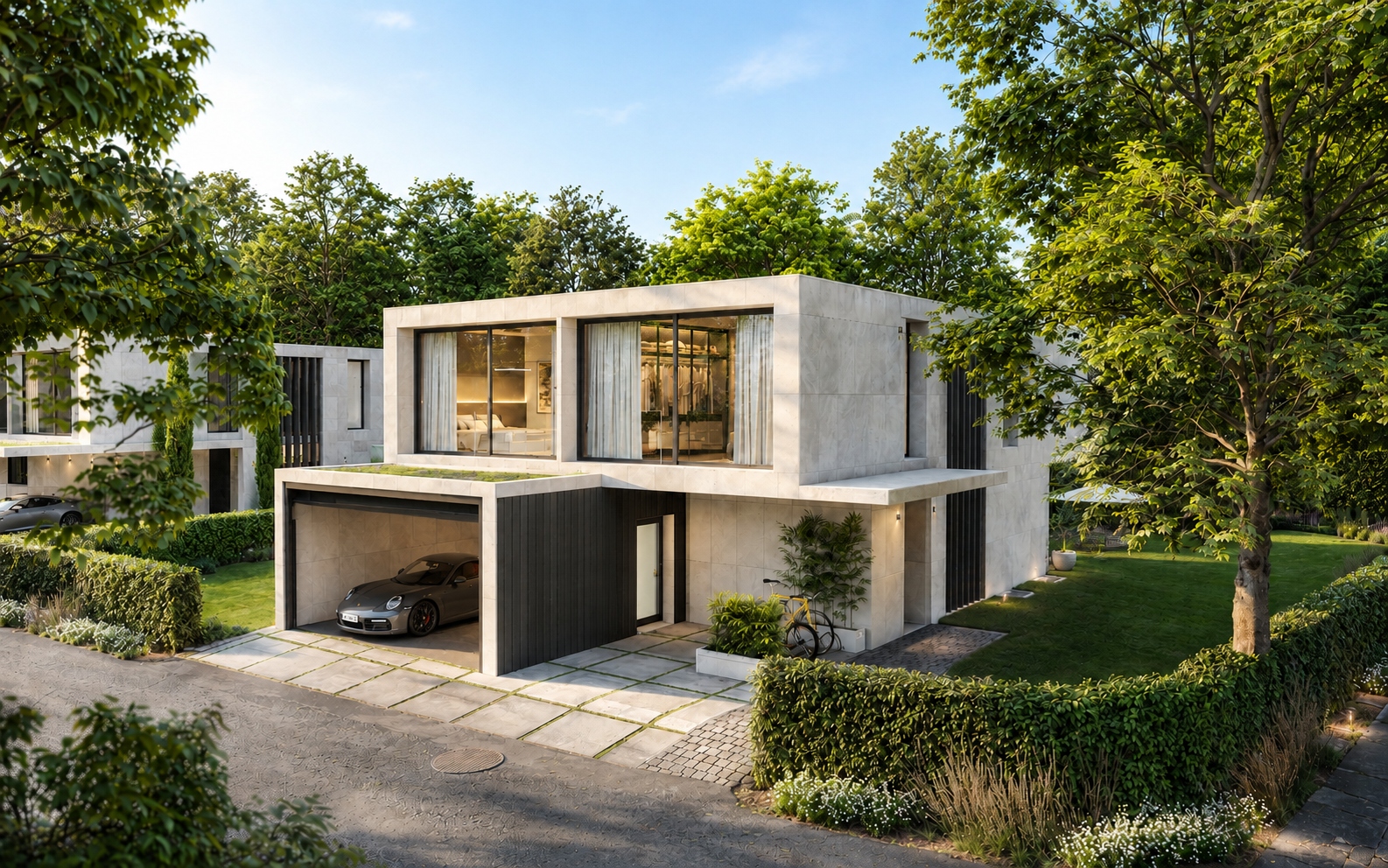
In Geneva, building a villa starts with the plot. In the villa zone (zone 5), floor area is in principle limited to 25% of the land area, a rate that can reach 27.5% for an HPE project and 30% for a THPE project, according to the canton of Geneva. Every new building must at least meet the HPE standard and preserve an area of open ground.
The budget, for its part, follows a construction market rising moderately: according to the Office cantonal de la statistique (OCSTAT), the Geneva construction price index rose by 1.2% year on year in April 2026. This guide sets out, in order, what an owner should check before launching a project.
Building a villa in Geneva: what zone 5 allows
Zone 5 is the building zone reserved for villas. The technical term to know is the floor area ratio (indice d’utilisation du sol, IUS): the ratio between the built floor area and the area of the plot. According to the canton of Geneva, the usual ratio in the villa zone is 0.25.
A worked example
On a theoretical plot of 1'000 m², the rates published by the canton give the following orders of magnitude:
| Scenario | Floor area rate | Floor area on 1'000 m² |
|---|---|---|
| General rule | 25% | 250 m² |
| HPE project | 27.5% | 275 m² |
| THPE project | 30% | 300 m² |
These figures are ceilings, not acquired rights. Boundary distances, easements entered in the land register and the shape of the land can reduce what can actually be built. An easement, such as a right of way, should be checked before any land purchase.
Density increase: possible, never automatic
The canton provides for a derogatory increase in the ratio. It may be considered under three conditions: the area is identified for densification in the municipal master plan, the project fits into the neighbourhood, and a sufficient share of open ground is retained. The derogatory ratio depends on the size of the plot and the energy standard. The canton points out that authorisation is not automatic. A financing plan should therefore never rely on an increase not yet obtained.
To place zone 5 within the Swiss system as a whole, our guide to building zones in Switzerland details the categories of zones and what is at stake.
The energy standard: HPE at minimum, THPE as an option
In Geneva, a new building must at least meet the HPE standard (high energy performance). The THPE standard (very high energy performance) goes further and, as the table above shows, entitles the project to a higher floor area rate.
The choice between the two standards is therefore also a choice of floor area. Aiming for THPE involves more demanding technical solutions (insulation, heat generation, ventilation), but can increase the living area permitted on the same plot. It is a trade-off to cost with the architect from the first sketch. To understand how a building’s performance is then documented, see our guide to the CECB in Geneva.
Open ground and the greenery index: the garden is part of the application
Since the end of the freeze in the villa zone, the canton requires every permit application in zone 5 to include the greenery index. This document describes the project’s effect on open ground, vegetation and water management. Open ground means soil that is not built on, either above or below ground, where water infiltrates naturally.
The canton specifies that this open ground must allow, in particular, the planting of large trees. In practice, an extensive basement, a swimming pool, hard-surfaced access or parking cover land and reduce this area. These choices are therefore made when the plot is first studied, not at permit stage.
What we check on site
- The footprint of the basement compared with that of the villa.
- Impermeable surfaces: access, parking spaces, terraces.
- Existing trees and those that can be planted.
- Rainwater management on the plot.
The budget: land, construction and price trends
The budget for a villa has three parts: the land, the construction and ancillary costs (studies, taxes, utility connections, financing). Land prices vary widely from one municipality to another; our guide to land price valuation in Geneva explains how to assess them.
For construction, the Office cantonal de la statistique publishes an index measuring changes in the prices charged by contractors. In April 2026, it stood at 100.4 points.
| Index (April 2026) | Year-on-year change |
|---|---|
| Geneva, all construction | +1.2% |
| Geneva, buildings | +1.0% |
| Lake Geneva region | +0.9% |
| Switzerland | +2.6% |
Source: OCSTAT, Geneva construction price index, April 2026.
Reading: in Geneva, the rise for buildings remains below the national average. For a project spread over several years, allowing a margin for price changes remains prudent. Orders of magnitude per m² are detailed in our guide to the cost of a new house in Geneva, and financing rules in the one on mortgage calculation and equity.
The steps of a villa project, in order
- Analyse the plot. Zone, applicable ratio, easements, slope, access, existing trees.
- Feasibility study. A first sketch translates the rules into square metres that can actually be built, with and without THPE.
- Financing plan. Land, construction, ancillary costs, contingency reserve and price changes.
- Project design. Plans, energy standard, greenery index, basement layout.
- Building permit application. The application must in particular include the greenery index; any density increase is assessed at this stage.
- Tenders and construction. Choice of contractors or a general contractor, monitoring of costs and schedule.
- Handover and commissioning. Inspection of the works, snagging, warranty documents.
Build, buy or add value to an existing plot
Not every project starts from bare land. The owner of an older villa on a large plot may wonder about the potential of the land: extending, rebuilding, dividing or selling with knowledge of what can be built. The value of a plot in zone 5 depends directly on these rules.
Your adviser can prepare an evidence-based valuation that takes this potential into account, and present the options for adding value to a property. For a concrete example of a new villa designed to the THPE standard, see the new villa in Collonge-Bellerive. You then decide, with no obligation to sign a mandate.
Frequently asked questions
What we are asked most often
How much floor area can be built on a plot in the villa zone in Geneva?
In principle, floor area is capped at 25% of the plot, a ratio of 0.25. This rate can reach 27.5% for an HPE project and 30% for a THPE project, according to the canton. A derogatory increase exists, but it is not automatic.
Which energy standard is mandatory for a new villa?
In Geneva, a new building must at least meet the HPE standard. The THPE standard is more demanding and allows a higher floor area rate in zone 5.
What is the greenery index?
It is a document to be attached to the permit application in the villa zone. It describes the project’s effect on open ground, vegetation and water management. It affects the footprint of the basement, access and outdoor landscaping.
Are construction prices rising in Geneva?
According to OCSTAT, the Geneva construction price index rose by 1.2% year on year in April 2026, and by 1.0% for buildings alone. The national increase reached 2.6% over the same period.
How can I find out the value of a building plot?
The value depends on the municipality, the area and what the rules allow to be built on it. Your adviser can prepare an evidence-based valuation of your property, with a response within 24 to 48 hours.
Sources
Where to check this information
- Indice genevois des prix de la construction, en avril 2026 (opens in a new tab) Office cantonal de la statistique de Genève (OCSTAT) ·
- Énergie : standards de construction neuve ou extension (opens in a new tab) République et canton de Genève ·
- Dans quels cas s’applique la majoration de densité en zone 5 ? (opens in a new tab) République et canton de Genève ·
- Fin du gel en zone villa : de nouvelles exigences pour préserver la qualité de la zone villa (opens in a new tab) République et canton de Genève ·