
Guide
Property auctions in Geneva: where to find properties in 2026
Property auctions do take place in Geneva, but they are rare and mostly result from forced sales organised by the debt enforcement office (Office des poursuites) or the bankruptcy office (Office des faillites). For reliable information, start with the Feuille d’avis officielle (FAO), which publishes cantonal legal notices and property sale notices, and with the État de Genève website, under the section on the debt enforcement and bankruptcy offices. There you will find the notices, sale dates, conditions, downloadable documents and their official updates. These two source…
Platforms specialising in Swiss property auctions reproduce and centralise these notices. They make monitoring easier and give access to practical information, but they rely on the official publications, which remain the only legal reference. In the event of a discrepancy, the official sale notice prevails.
Whether you are a private buyer or an investor, resident in Switzerland or abroad, one point should be understood before you start, including if you are targeting residential or prestige property in the canton’s sought-after neighbourhoods. These sales remain few in number, properties are sold as seen, and the presence of secured creditors and experienced buyers often drives bids up. The idea of an automatic bargain does not stand up to scrutiny.
Voluntary auction or forced sale: the first distinction to make
A voluntary sale is chosen by the owner, often to speed up the transaction or to create competition between buyers. The conditions are more flexible: multiple viewings, complete documentation, room for negotiation on certain aspects. This method remains uncommon in Geneva property and mostly concerns high-end properties.
A forced sale results from debt enforcement proceedings, a bankruptcy or the realisation of a property pledge by a creditor, usually a bank. The cantonal debt enforcement office or the bankruptcy office organises the session and sets the conditions. The property is sold as seen, without warranty, and payment deadlines are strict.
It is this second category that accounts for most property auctions in Geneva, and it is this category that imposes the constraints detailed below.
Who can bid?
Public auctions are open to adult individuals and to companies, resident in Switzerland or abroad, subject to the LFAIE, the federal law on the acquisition of real estate by persons abroad, better known as the Lex Koller.
Four practical conditions:
- Identity. An official identity document is required. For a company, an extract from the commercial register.
- Financial guarantee. A deposit or down payment is generally required, payable before the sale or on the day. The amounts frequently run to tens of thousands of francs.
- Proof of funds. Some offices require evidence of financing, in the form of a bank pre-approval or proof of own funds.
- Status under the LFAIE. A person resident abroad must obtain cantonal authorisation, except for exemptions provided by law. Whether the law applies depends on nationality, residence and the intended use of the property. Have your situation checked before the sale date, not after the award.
No particular qualification is required beyond these formalities. The process is open.
Which properties go to auction?
The density of the Geneva market produces a varied range of lots, which also reflects the dynamics of the local property sector:
- Condominium (PPE) flats in the city, from 2 to 6 rooms
- Villas and semi-detached houses in residential municipalities
- Entire residential buildings, sometimes large ones
- Mixed-use buildings combining shops, offices and housing
- Car parks, garages and parking spaces
- Co-ownership shares, for example half of a PPE flat
This last case deserves attention. Acquiring a share does not give you control of the property: you become a joint owner with the other holder, with the legal constraints this implies.
An equally important point: properties are often occupied, by sitting tenants or by the former owner. The buyer takes over the existing leases and the obligations attached to them. This factor determines both the yield and the future use, and it must be built into the calculation before the session, not after.
How a session unfolds
The sale takes place on the premises of the office concerned, at the location stated in the official notice. Participants are registered on arrival: identity check, issue of a bidder number and, where applicable, payment of the required guarantee. The terms and conditions of sale (cahier des charges) are then read out, at least in their essential points: conditions of sale, mortgage charges, existing leases, easements, registered claims. The actual presence of buyers and creditors strongly influences the dynamics of the session.
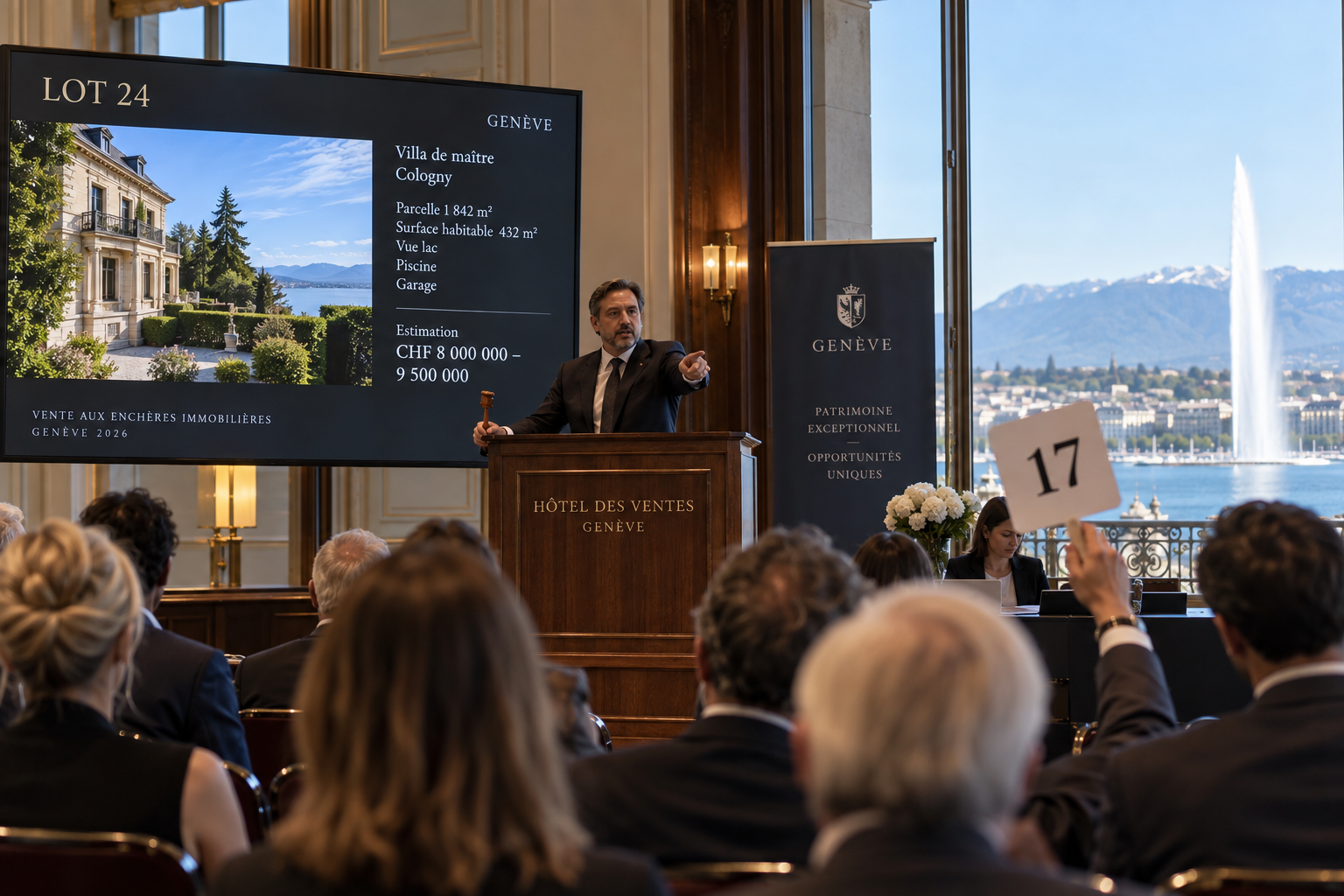
Bidding is conducted by open outcry. In forced sales, no starting price is necessarily set and bids open freely. Participants raise their bids orally, and the official makes repeated calls after each bid before awarding the property to the highest bidder.
The creditor bank and other secured creditors are often present and may bid themselves. In practice, this prevents an award at a derisory price. The award must also cover the claims secured by prior-ranking pledges, which sets an effective floor.
One point to weigh before raising your hand: the award is in principle final on the day, subject to any statutory or contractual rights of pre-emption. There is no condition precedent and no right of withdrawal. Once the hammer falls, you are committed.
Documents to examine before bidding
The terms and conditions of sale are the reference document: they bind you legally and you are deemed to accept the legal and physical condition of the property as described in them. The conditions of sale are published before each session.
To be analysed systematically:
- Terms and conditions of sale: conditions of the sale, payment deadlines, deposits, obligations after the award
- Land register extract: current owner, history, restrictions
- Mortgage certificate: land charges, easements, rights of way
- PPE regulations where applicable: common parts, charges, planned or approved works
- Plans and floor areas: actual living area, terrace, balcony, orientation
- Expert or valuation report, often included in the file
- Technical surveys where available: electrics, plumbing, heating
- Schedule of leases: sitting tenants, current rents, term, notice periods
For complex files, such as investment buildings, ongoing disputes or multiple claims, have everything reviewed by a notary or a specialist lawyer. The cost of this review bears no comparison with that of a poorly assessed award.
The viewing: what you can check, and what will escape you
Offices generally publish one or two viewing dates, announced in the sale notice. These slots are short and one-off, so prepare for them.
What can be checked on site:
- The condition of the façades, roof, windows, plumbing, heating and insulation
- Access, parking, cellars and outbuildings
- Views, orientation, noise levels and neighbourhood
- Actual floor areas, compared with the stated areas
- The condition of the common parts in a PPE: lift, stairs, entrance hall
What will escape you: the condition of concealed installations such as pipes and structure, hidden defects, and exact compliance with building permits. This is precisely what a sale as seen leaves at your expense. Come with an architect, an engineer or a contractor, and cost the works before the session rather than after.
Take photos and send your questions to the office in writing, keeping the replies.
Starting price, bidding and real value
In forced sales, bidding often opens without an announced floor price. When a reserve price is set, it may be well below the estimated value in order to attract bidders. But competitive bidding generally brings the final price back towards the market as soon as several buyers are in contention.
The gap between valuation and award is therefore not a secured margin; it is a hypothesis to be tested. To assess a property’s value independently of the office’s valuation, rely on comparable transactions and on property prices in Geneva by municipality.
The rule of discipline fits in one sentence: set your maximum price before the session, including foreseeable works, charges, ancillary costs and expected yield, and do not exceed it under any circumstances.
Financing and guarantees
Without financing fully in place, taking part in an auction is unwise.
The guarantee deposit is required in order to bid. It takes the form of a percentage of the reserve price or a fixed amount set by the office, stated in the conditions of sale.
Evidence of financing requires a bank pre-approval or proof of own funds. Contact your bank in advance, telling it that this is an auction: the timetable and the absence of a condition precedent change how the application is processed.
The payment schedule is set by the terms and conditions of sale and remains short after the award. Interest may accrue if payment is deferred.
The risk of default is the direct counterpart: if you fail to pay, you lose your guarantee and expose yourself to damages. This is the fundamental reason never to bid beyond your confirmed means.
Costs to add to the award price
The award price is not the acquisition cost. To be budgeted on top:
- Cantonal registration duties, calculated on the price
- Land register fees for recording the transfer
- Notary fees for checking title and transferring ownership
- Financing costs: bank arrangement fees, mortgage fees
- Insurance: buildings, owner’s third-party liability
- Renovation works, often the largest item for properties from bankruptcies or poorly maintained properties
Tax on property profits and gains concerns the seller or the bankruptcy estate, not the buyer, but it can indirectly influence the reserve price strategy, particularly as the award price does not always cover the total of the debts or amounts owed, apart from the distribution and ranking mechanisms.
Risks specific to auctions
Properties are sold without warranty, which shifts the entire risk onto the buyer.
Hidden defects. Structural cracks, damp, non-compliant installations, defective finishes. Without a prior survey, the cost of repairs can absorb the margin.
Disputes with occupants. A former owner who refuses to leave, tenants opposed to the takeover, long and costly eviction proceedings.
Complex legal situation. Residual mortgages, onerous easements, ongoing administrative proceedings, works carried out without authorisation.
Emotional overbidding. The dynamics of the room push bidders beyond their limit. This is the most common risk, and the only one that depends entirely on you.
Tight deadlines. The balance is due within a fixed period, and raising the funds in time becomes difficult if financing was not in place before the session.
What auctions really offer
For investors, access to entire buildings is the main attraction, as this type of property almost never comes onto the conventional market. Opportunities for restructuring and optimising rents exist, within the strict limits of Geneva tenancy law and cantonal housing regulations.
For private buyers, an auction can make it possible to acquire a home on more favourable terms than a conventional sale, typically when the property needs work or presents poorly. The condition remains the same: competition must be weak on the day, which cannot be predicted.
In both cases, the opportunity is judged not on the award price but on the total cost, including disputes, works and regulatory constraints. Buying below the valuation means nothing if hidden costs absorb the difference.
The legal framework and the role of the offices
The canton’s debt enforcement office and bankruptcy office conduct the entire process: setting dates, informing the public, holding sessions, awarding properties. The conditions of sale are governed by the federal law on debt enforcement and bankruptcy, supplemented by land law and Geneva cantonal rules.
One Geneva-specific feature is worth knowing for investors: the regulations on the designated use of housing. Buildings intended for residential use have sometimes been operated as furnished residences for commercial use. After an auction, the question of a return to the original use may lead to proceedings and a reduction in rents, with a direct effect on the expected return. This risk cannot be read in the award price; it can be read in the building’s administrative status.
Preparing for an auction: the method
- Follow the notices. Regularly check the FAO and the État de Genève website. The time between publication and sale can be short.
- Always view. No file replaces a viewing, even when everything seems clear on paper.
- Model several scenarios. Future rents, vacancy, works, on cautious assumptions, to arrive at your maximum price.
- Get support. For a first participation, a notary, a lawyer, a broker or an experienced investor will help you avoid the most costly pitfalls.
- Attend first as an observer. A session observed with nothing at stake teaches you the pace and the conventions better than any documentation.
- Stick to your limit. The end of the session is when pressure peaks. Your maximum price is your only protection.
Frequently asked questions
What we are asked most often
Where can I find property auctions in Geneva?
Two official sources publish all property auctions in the canton. The Feuille d’avis officielle (FAO) carries cantonal legal notices, including property sale notices. The État de Genève website, under the section on the debt enforcement and bankruptcy offices, provides the notices, session dates, conditions of sale and downloadable documents. These two channels cover all properties put up for sale by the Geneva offices. Platforms specialising in Swiss property auctions centralise these notices and make monitoring easier, but they simply reproduce the official publications, which remain the only legal reference. As the time between publication and sale can be short, regular checking is necessary.
Is it worth buying a property at auction?
It depends on your capacity to absorb risk, not on the stated gap with the valuation. The main attraction lies in access to properties absent from the conventional market, notably entire buildings, and in the possibility of acquiring a property needing work on better terms than an ordinary sale. The trade-offs are real: the property is sold as seen without warranty, the award is final with no right of withdrawal, existing leases are taken over as they stand and the balance must be paid within a short period. The presence of secured creditors in the room also limits price gaps. The transaction becomes worthwhile when the price paid accounts for works, possible disputes and regulatory constraints, not simply when it is below the valuation.
Which website is best for following auctions in Switzerland?
No private website replaces the official publications. For Geneva, the FAO and the État de Genève website are the reference source, and each canton publishes its sales on the same principle, through its official gazette and the website of its debt enforcement and bankruptcy offices. Private platforms specialising in Swiss auctions are of practical use: they aggregate notices from several cantons and offer alerts by criteria. However, they depend on the official publications for their updates, and their completeness is not guaranteed. Use them for monitoring, and always check the official sale notice before taking any step.
What are the pitfalls of property auctions?
Five risks come up consistently. First, hidden defects, since the property is sold without warranty and a single viewing does not allow you to check concealed installations or compliance with building permits. Next, disputes with occupants, whether a former owner refusing to leave or lengthy eviction proceedings. The legal situation, which may involve residual mortgages, onerous easements or ongoing administrative proceedings. Emotional overbidding, driven by the dynamics of the room, which remains the most common pitfall and the only one entirely within your control. Finally, payment deadlines, as a default leads to the loss of your guarantee and exposure to damages. The safeguard comes down to two steps: read the terms and conditions of sale in full and set a maximum price before the session.